Monday, July 11, 2011

Lehnert & Landrock - 1905-1925


Lehnert & Landrock met in Switzerland in 1904. They were both 26 at the time, the former Austrian, the latter German. Both had been dreaming of visiting and working in the "Orient". German travel writers, explorers, archaeologists and anthropologists had done major studies of the Near East, especially in the 19th century, and this may have influenced their decision to settle in Tunis the year of their meeting. After World War I, upon their return to the Mahgreb, they were again in Tunis, and later in Cairo. Indeed, the firm still exists in Cairo today under the same name. A relative of Landrock donated all the known plates to the Musée de l’Élysée in Lausanne.
There have been numerous articles and monographs about their work and increasingly L & L are becoming recognized as one of the best studios working in this area during this period. The photographs were, in fact, taken by Lehnert, while Landrock supplied the business acumen. Lehnert also worked for a brief period (1922-24) in Algiers for Jouvet, although Jouvet’s studio mark does not credit him. Lehnert made a body of independent work, mostly of male and female nudes. They are quite rare, though some have appeared at auctions, most recently in a lot of male erotica including von Gloeden et al. in a Christie’s London sale.
There are several distinguishing features to a Lehnert photograph. Desert scenes are simple, but formally composed (Desert Lookouts, Desert Sentinels) reflecting his early training as a painter and art student. Lone figures, or a group of lone figures are usually dwarfed by sand dunes, forming one of his favorite motifs, the power and influence of the desert and nature over man. There is a large body of female nude work, and of eroticized male adolescent images. Nude with Veil is especially representative of this genre. Such work was exceptional for the other photographers working in North Africa, but for L & L we might call it common. Several important female and male images are posted in the Gallery section, including two rare silver prints (Harem Nudes, Nude with Veil).
The output of the firm was enormous. It included vintage photographs, heliogravures, original photographic postcards, heliogravure postcards, and contributions to innumerable books. See Bibliography below for a list of reference works.


Very beautiful work, at times reminds me of a mix between EJ Bellocq and Edward S Curtis. Without question the models were subjected to the fetishisation (sp?) of Orientalism, although whether it was malicious or curious I do not know. Their more comprehensive exploration of Cairo, and other cities, seem earnest and thoughtful.


For more information visit these sites:


Thursday, June 30, 2011

Thursday, June 2, 2011


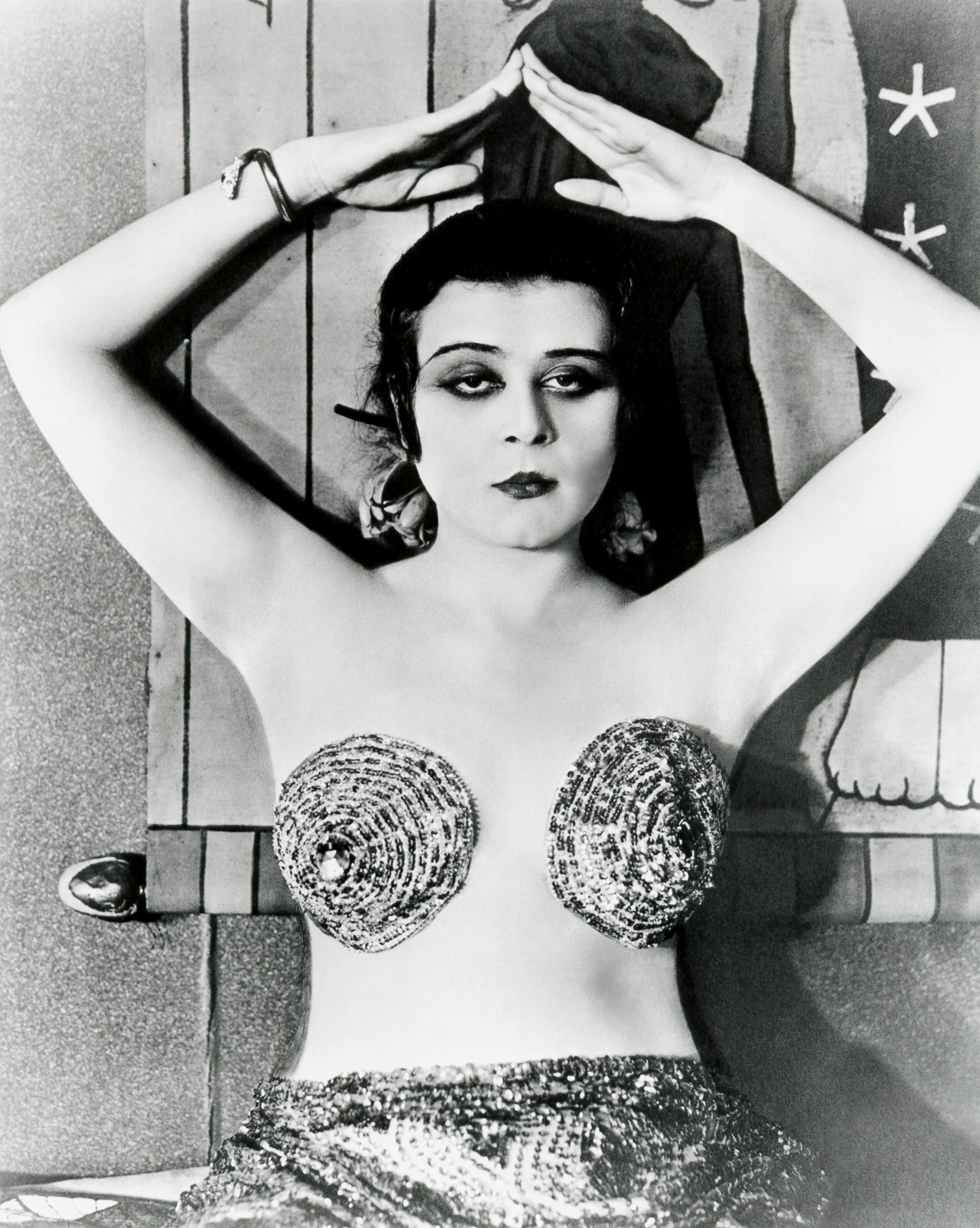
How Theda Bara Became Silent Film's Supernatural Siren


Theodosia Goodman was a tailor’s daughter from Cincinnati. People who knew her growing up said she was a “nice Jewish girl.” Then she changed her name to Theda Bara and started making movies. In 1915 she starred in A Fool There Was. Listed in the credits as simply the Vampire, occasionally shortened to the Vamp, she was a temptress who lured men to ruin, mouthing lines like “Kiss me, my fool!” The movie itself was unremarkable, but the way it was marketed was revolutionary. The fledgling Fox Film Corporation tasked its new publicity department, staffed by two former New York World reporters, with fabricating a backstory for the Polish-American starlet. At a press conference for A Fool, the assembled journalists were told that Bara was the Serpent of the Nile, born in the Sahara to a French actress mother and an Italian sculptor father, and raised “in the shadow of the Sphinx.”

Bara became one of the biggest stars of the silent era—rivaling Charlie Chaplin and that goody-two-shoes Mary Pickford. She was happy to play along with the vamp image, wearing veils and black clothing and slathering on dark eye makeup. She would laugh uproariously at the latest bit of invention printed about her in the papers—one item described a 2,000-year-old emerald ring supposedly given to her by a blind, wizened old sheik. For press events, Fox encouraged her to use an exotic accent and profess her interest in mysticism and the occult. Bara even posed with skeletons for several publicity photos; the message was that she was a supernatural siren who literally devoured men.

Bara made 39 films from 1915 to 1919, wearing outfits onscreen that even today would be considered revealing. The titles say it all: The Forbidden Path, The Vixen, The Devil’s Daughter, The Eternal Sappho, When Men Desire, and, of course, Sin. She made a few attempts to play a good girl, but those films always disappointed, proving yet again that there’s no escape from the dark side.


Article courtesy of Wired Magazine
For more images please visit:

Tuesday, May 24, 2011

Excerpts from a remembered conversation...

The photographer I spoke with created all these cameras/sculptures out of found objects. He was one of the smartest people I've ever encountered. After our meeting my head was spinning and I ran home to write down what I recalled from our discussion.


Extracting....night and day....Reversing language

It’s so far beyond the event, but it sounds like…it reminds us of it. If we look hard enough, it looks similar to it, but it just LOOKS like the reflection. Even the illustration only illustrates another illustration


...it was volatile. If we push it too far, or if we do something wrong with it, the consequences would be grave.

It’s scary we have all these ideas of security and person hood and place, when we are just reflections...


...it’s like someone is talking to you backwards and you have to figure it out...


...The poetry of the light and camera, to adjust it is scary. It’s like we don’t know what we’re messing with

Something volatile.

The interest that you have to take the picture in the day and extract it at night….life and death…

Sunday, January 23, 2011

Recently, a few students have asked me to participate in individual research papers dealing with varying theoretical topics. Their questions were exciting and thoughtful, I wanted to share some of them along with my candid and honest answers.

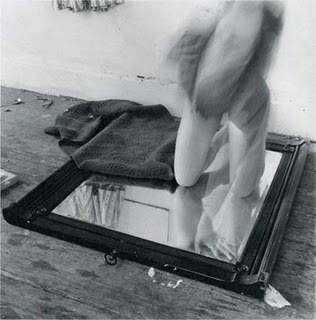
Francesca Woodman


- How do you interpret Lacan's Mirror Stage and Three Orders Theories in terms of Photography?

It is fascinating to discuss Lacan’s theories in terms of photography. Since photography’s inception, no one has been able to pin down exactly what photography is or does. The medium’s nature itself forces fragmentation of experience, memory, and permanence.

As William Ivins Jr. describes in his text Prints and Visual Communication, 1953, Harvard Press: "at any given moment the accepted report of an event is of greater importance than the event, for what we think about and act upon is the symbolic report and not the concrete event itself." Concluding that: "The nineteenth century began by believing that what was reasonable was true and it would end up by believing that what it saw a photograph of was true."

We see Ivins’ speculation played out every evening in courtroom and tabloid dramas. But how does the viewer actually digest photographs? Does the 2011 layman, even believe the photograph, or have we all just conceded that photography is at best an illustration, painted with pixels.

The argument over whether or not Photography is real or true has been discussed into the ground. Surely no discerning viewer or maker believes the implied veracity of the image. So what does the photograph then show? Not the truth, but a truth. The photograph is fragmented in purpose and interpretation.

The photograph imparts information, but that information is not stable. It changes and morphs in front of our very eyes. Consider the physics; the human brain can detect movement at a rate close to 1/60th of a second, thus when you make an exposure at 1/8000th you have captured something physically impossible for one to have experienced. The same can be said if you photograph something at roughly 1/30th of a second, the photographer has slammed two realities into each other. Compound that with our vision, if you had to compare the way we see with a lens, it would be about 50mm based on a 35mm negative. Again, meaning that if you shoot at 18mm, you could not have ever experienced that perspective.

How do we then decipher this information? If we know the camera sees differently than we do, why is that they are still able to match our memories? Much like photography, memory is not stable. Memory changes and modifies with experience, in fact each time we “remember” something, we are destroying it. We project all of our current knowledge and feelings into the memory, making it match our current reality. So then, do photographs create the memory? Does the memory create the photograph? Perhaps even further, do the images represent the camera’s memory, and we’re just trying to reassemble the pieces?

Eadweard Muybridge

Despite the appearance of resemblance between the image and it’s referent, the iconic sign is, nonetheless, like other sign systems, completely arbitrary, conventional, and unmotivated - Umberto Eco

If this so, why is it that photographs still have power, and still conjure emotion? Is it possible that photographs can physically change to align with our experience? People, objects and places can rearrange themselves in front of our eyes? Can we organize the fragments, and align them to match what we think we remember?

Yes. The easiest example is one any lovelorn 14 year old can explain. View a picture of a boyfriend/girlfriend while you are in the relationship. The figure in the picture will glow with charm, love, and beauty. After the relationship dissolves, revisit the image. The photograph now shows a disfigured monster leading you to question your sanity and standards.

Even better, as a student, how many times during critique do you hear someone sound oblivious to the fact that there is a tree growing out of someone’s head? The maker in question probably stared at the picture for many hours, and never saw this. The reason being he or she was able to decide how they wanted the image to look, and miraculously, it appeared that way.

There is a theory/story/myth that often gets repeated about Columbus and his three ships arriving to the new world (though it is more likely attributed to Captain Cook in regards to landing on the Australian coast.) The story describes how the indigenous peoples literally could not see the ships anchored off their coasts. Not because of a trick or light or other anomaly, but because they had no knowledge of European schooners, or that they had even existed. It wasn’t until the shaman noticed the rippling of the water, that he began to scan the horizon and consider the possibility of what was out there. Only when he stopped expecting, and started looking was he able to see.

To paraphrase Duane Michals, humans seek confirmation, not revelation.

So I make myself the measure of photographic ‘knowledge.’ What does my body know of Photography? I observed that a photograph can be the object of three practices (or three emotions, or of three intentions): to do, to undergo, to look. The operator is the photographer. The spectator is ourselves, all of who glance through collections of photographs in magazines, newspapers, in books, albums, archives…And the person or thing photographed is the target, the referent, a kind of little simulacrum, any eidolon emitted by the object, which I should like to call the Spectrum of the photograph, because this word retains, through its root, a relation to ‘spectacle’ and adds to it that rather terrible thing which is there is every photograph: the return of the dead. – Roland Barthes

Eddie Adams

- Most people take a photograph at face value. Basically, they see a photograph and they don’t question it. This certainly makes it easier for a photographer now that his work isn’t constantly questioned. But as with the famous Vietnam War era photograph showing the execution of the prisoner convicted of killing civilians...Does the danger of sending the wrong, potential damaging message, outweigh the benefit of being basically given the benefit of the doubt? [sic]

I think we have reached an age where the veracity of the medium is challenged by reflex. The phrase “It looks ‘shopped” has become such a part of our vernacular that people freely spout it without knowing the actual program. That being said, I don’t know if it’s accurate to assume people ever truly believed the medium. I think manipulation is much easier at the moment, but that’s not to say it wasn’t possible and used constantly since the medium’s discovery. I think one only needs to look as far as Hippoylte Bayard’s “Self Portrait as a Drowned Man” created in 1840 to see evidence of this. The image depicts a corpse propped up, when in reality it’s a self portrait of the photographer. What is amazing about this, is that photography had been patented less than a year when Bayard created it (He was known to be producing photographs before Daguerre’s fame, but lacks the recognition.) So consider that Bayard, deliberately told a lie and masked it as the truth, photography would never be the same.

Hippolyte Bayard

I ask you the question, is a photograph more acceptable as truth if looks most similar to reality? How can you compare the carefully choreographed images of Jeff Wall with something like an AES F creation? Both fictitious, both staged, but one certainly looks more real, and is thus judged as so. Does the old adage still hold water, are the best lies 95% true?

Jeff Wall

AES F

What is interesting is that, to an extent, none of this matters. People don’t need facts to form opinions nor do they require evidence to prove things. The suspension of disbelief. We are capable of staring at an image and simultaneously doubt and believe it. It’s the same reason why we enjoy television shows, or 3rd grade plays…the audience doesn’t actually think a 9 year old in a cardboard hat is Lincoln, but after only a scant few moments, the child transforms.

The dangers and wonders of this are vast. Photography never tells the truth, but it can tell a truth; a truth that people already believe. Photographic propaganda is still a real and effective tool. Think about the Spanish-American war in 1898, which was basically fabricated by William Randolph Hearst and other newspaper publishers. The media often faked and exaggerated images and passed them off as truth. In the early stages of the war, Hearst sent photographers down to document the carnage, of course when they arrived there was only peace. Understandably they wired back to Hearst:

"Everything is quiet. There is no trouble. There will be no war. I wish to return."

To which Hearst's replied:

"Please remain. You furnish the pictures and I'll furnish the war."

1898


- When you boil a photo down to it’s most basic, it is really just a random bunch of dots on a piece of paper. Yea it has the amazing ability to move people so much that they are left breathless or spurred to action. What is the cause of this? [sic]

Well when you break down any object in the universe, at the atomic level we are all just billions and billions of matter particles. What is interesting though is that the photographic print seems to defy normal human perception. Without the use of magnifiers, in life, when we get closer to something, the more clear it becomes. It photography there is a breaking point, if you get too close, the dots are all you see and the larger picture disappears. Very similar to a Chuck Close painting, the forest is often obscured by the trees.

Humans have magnificent abilities to order and arrange information into recognizable objects. This is called simulacrum or visual matrixing, the way we can look at clouds and see bunnies.

Once again proving that we see what we want to see, and only look at a small portion of the information and then fill in the rest with what we wish. Please research the phenomena of Persistence of Vision as physical proof of this.

Chuck Close


- How big a role do you think Photography has played in changing the course of human events? How has photography influenced social and political reform, environmental issues or in science? [sic]

Photography articulates the unarticulatable. It has no age, sex, language, or race…photography is the perfect amorphous gray blob. It has no beginning or end, nor is it black or white. Photography can be and IS everything, it serves every purpose. For these reasons, it is a fantastic vehicle to inspire change, emotion, information, and action.

Saturday, January 22, 2011


Wolves by the road and a bike wheel spinning on a pawnshop wall
She’ll wring out her colored hair like a butterfly beaten in a summer rainfall


A ditch in the dark in the ear of the lamb who’s going to try to run away
Whoever got that brave?


Wolves in the middle of town and a chapel bell ringing through the windblown trees

Wolves at the end of the bed and a postcard hidden in her winter clothes
She’ll weep in the back of a truck to the traitors only trying to find her bullet hole
and then run down a canopy road to some mother and a baby with a cross to bear

The song of the shepherd’s dog
a little brown flea in the bottle of oil
for your wooly wild hair,
you’ll never get him out of there


Monday, December 6, 2010


I'm sorry but I don't want to be an Emperor - that's not my business - I don't want to rule or conquer anyone. I should like to help everyone if possible, Jew, gentile, black man, white. We all want to help one another, human beings are like that.

We all want to live by each other's happiness, not by each other's misery. We don't want to hate and despise one another. In this world there is room for everyone and the earth is rich and can provide for everyone.

The way of life can be free and beautiful.

But we have lost the way.

Greed has poisoned men's souls - has barricaded the world with hate; has goose-stepped us into misery and bloodshed.

We have developed speed but we have shut ourselves in: machinery that gives abundance has left us in want. Our knowledge has made us cynical, our cleverness hard and unkind. We think too much and feel too little: More than machinery we need humanity; More than cleverness we need kindness and gentleness. Without these qualities, life will be violent and all will be lost.

The aeroplane and the radio have brought us closer together. The very nature of these inventions cries out for the goodness in men, cries out for universal brotherhood for the unity of us all. Even now my voice is reaching millions throughout the world, millions of despairing men, women and little children, victims of a system that makes men torture and imprison innocent people. To those who can hear me I say "Do not despair".

The misery that is now upon us is but the passing of greed, the bitterness of men who fear the way of human progress: the hate of men will pass and dictators die and the power they took from the people, will return to the people and so long as men die [now] liberty will never perish...

Soldiers - don't give yourselves to brutes, men who despise you and enslave you - who regiment your lives, tell you what to do, what to think and what to feel, who drill you, diet you, treat you as cattle, as cannon fodder.

Don't give yourselves to these unnatural men, machine men, with machine minds and machine hearts. You are not machines. You are not cattle. You are men. You have the love of humanity in your hearts. You don't hate - only the unloved hate. Only the unloved and the unnatural. Soldiers - don't fight for slavery, fight for liberty.

In the seventeenth chapter of Saint Luke it is written " the kingdom of God is within man " - not one man, nor a group of men - but in all men - in you, the people.

You the people have the power, the power to create machines, the power to create happiness. You the people have the power to make life free and beautiful, to make this life a wonderful adventure. Then in the name of democracy let's use that power - let us all unite. Let us fight for a new world, a decent world that will give men a chance to work, that will give you the future and old age and security. By the promise of these things, brutes have risen to power, but they lie. They do not fulfil their promise, they never will. Dictators free themselves but they enslave the people. Now let us fight to fulfil that promise. Let us fight to free the world, to do away with national barriers, do away with greed, with hate and intolerance. Let us fight for a world of reason, a world where science and progress will lead to all men's happiness.

Soldiers - in the name of democracy, let us all unite!

Look up! Look up! The clouds are lifting - the sun is breaking through. We are coming out of the darkness into the light. We are coming into a new world. A kind new world where men will rise above their hate and brutality.

The soul of man has been given wings - and at last he is beginning to fly. He is flying into the rainbow - into the light of hope - into the future, that glorious future that belongs to you, to me and to all of us. Look up. Look up.

- C.C., The Great Dictator, 1940


Richard Avedon, 1952